
'
'
🎯 CEOs & Leaders: Are Your OKRs Driving Behaviour or Just Decorating Your Dashboard?
As you finalise your goals and OKRs, ask yourself one important question: Are they actually influencing how employees work every day, or are they just impressive-looking numbers on a spreadsheet? 📊
Here’s the catch: If OKR achievement doesn't play a meaningful role in performance reviews, compensation, promotions, and employee evaluations, don't expect people to take them seriously. Without real accountability, OKRs risk becoming an annual corporate ritual rather than a performance-driving tool!
🏆 Achievement Is More Than Hitting Numbers
OKR success isn't just about ticking off Key Results. It's also about how well employees manage their goals, tackle roadblocks, adapt to challenges, learn from failures, and double down on what works. The journey matters just as much as the scoreboard!
💼 Why Should Sales Teams Have All the Fun?
In most companies, sales teams have clear targets, and their performance and compensation are directly linked to results. But what about the rest of the organisation?
Non-sales teams are often evaluated using rather fuzzy parameters like "built a high-quality product", "good team player" or "demonstrated ownership". Sounds nice, but where are the measurable outcomes? 🤔
📈 The 70/30 Rule: Make Performance Measurable
A practical approach: Tie 70–80% of performance evaluations to measurable OKR achievement, while leaving the remaining 20–30% for qualitative factors such as teamwork, creativity, leadership, collaboration and ownership.
Remember, what gets measured gets attention. What gets rewarded gets action! 🚀
' '
🔥 5 Golden Rules of Sales OKRs
- Clarity over complexity.
- Results over activity.
- Consistency over intensity.
- Accountability over excuses.
- Progress over perfection.
'
1. 🎯 Keep Objectives Clear: Set ambitious but easy-to-understand goals. Everyone should know what the sales team is trying to achieve.
2. 📊 Make Key Results Measurable: Replace vague targets like "increase sales" with specific numbers, deadlines and outcomes.
3. 🚀 Focus on Three Priorities: Limit quarterly Objectives to three major goals. Too many priorities dilute focus.
4. 💰 Connect OKRs to Revenue: Ensure your sales OKRs contribute to revenue growth, profitability or customer acquisition.
5. 📞 Track Prospecting Activity: Measure calls, emails, meetings and meaningful conversations with potential customers.
6. 🧲 Prioritise Qualified Leads: Don't celebrate lead volume alone. Focus on prospects who have genuine buying potential.
7. 🤝 Improve Conversion Rates: Track how effectively your team converts leads into meetings, proposals and paying customers.
8. ⏰ Set Weekly Milestones: Break quarterly targets into weekly goals. Smaller milestones make big targets less intimidating.
9. 👥 Assign Clear Ownership: Every Key Result should have someone responsible for driving it forward.
10. 📈 Monitor Pipeline Health: Track pipeline value, deal velocity, sales cycle length and opportunities at each stage.
11. 🔄 Review OKRs Weekly: Don't wait until quarter-end to discover that your sales strategy needs fixing.
12. 🧠 Learn from Lost Deals: Analyse why prospects say no. Turn lost opportunities into lessons for future wins.
13. ⚡ Focus on Leading Indicators: Monitor activities that predict future revenue, not just closed deals.
14. 🎁 Reward Meaningful Progress: Celebrate improvements in prospecting, conversions, customer acquisition and revenue.
15. 🛑 Avoid Vanity Metrics: Thousands of website visits mean little if they don't generate qualified prospects.
16. 🎨 Create a Sales Vision Board: Display quarterly targets, revenue milestones and team achievements to keep everyone motivated.
17. 🤖 Use Technology Wisely: Leverage CRM dashboards and automation to track progress without drowning in spreadsheets.
18. 🔍 Keep Targets Realistic: Consider historical performance, team capacity, market conditions and available resources before setting targets.
19. 🔧 Adapt When Necessary: OKRs should provide direction, not become rigid rules. Adjust initiatives when the numbers reveal a better approach.
20. 🏆 Celebrate the Wins: Recognise individual and team achievements. A motivated sales team is a powerful growth engine.
'
'
Turn sales ambitions into measurable targets, consistent action and revenue that actually shows up.
### 🚀 1. Stop Chasing Targets. Build Progress
How many times have you set an ambitious sales target, started with enthusiasm and lost momentum halfway through the quarter? It happens. The problem isn't always a lack of ambition; sometimes, it's a lack of direction. Sales OKRs help turn big revenue ambitions into smaller, measurable actions that keep your team moving. Instead of obsessing over the final number, focus on the activities and milestones that get you there.
💬 "Great things are done by a series of small things brought together." — Vincent van Gogh
### 🎯 2. Focus on Objectives, Not Just #s.
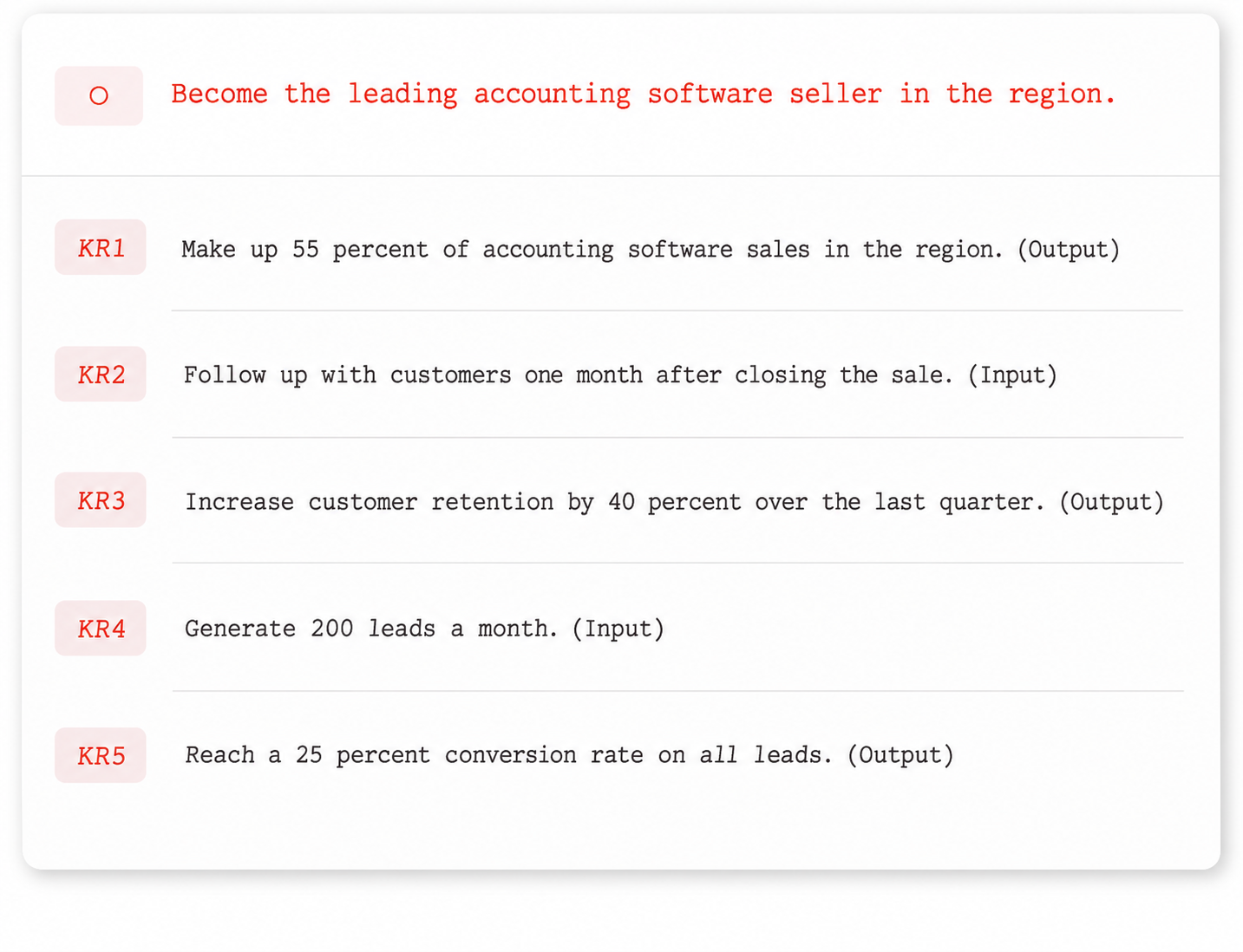
An Objective tells your sales team what they want to achieve. It should be clear, inspiring and ambitious. Key Results define how you'll know you've achieved it. Don't confuse the two! "Increase sales" is an objective, while "Generate 200 qualified leads" is a measurable Key Result.
Think of it this way: the Objective is your destination; Key Results are the milestones that prove you're getting closer.
💬 "The purpose of business is to create and keep a customer." — Peter Drucker
### 📈 3. Measure Movement, Not Just Revenue.
Revenue is important, but it doesn't tell the whole story. A sales team needs to measure the activities that create revenue, too. Track qualified leads generated, prospect meetings booked, proposals submitted, follow-ups completed and deals closed.
Break your quarterly goals into monthly, weekly and daily milestones. Small wins compound, and consistent activity creates a healthier sales pipeline.
### 🧠 4. Don't Conquer Every Target at Once
Having 15 sales priorities doesn't make your team ambitious; it makes everyone confused! Choose a maximum of three major Objectives for a quarter. Give each one a clear purpose and measurable Key Results.
For example, prioritise new customer acquisition, improve conversion rates and increase revenue from existing customers. Keep the focus sharp. Your salespeople should know exactly what deserves their attention when Monday morning arrives.
💬 "The key is not to prioritize what's on your schedule, but to schedule your priorities." — Stephen R. Covey
### 📝 5. Make Sales OKRs Specific & Realistic
Vague goals produce vague results. "Get more customers" sounds exciting, but what does it actually mean? Replace it with a measurable outcome, such as acquiring 50 new paying customers by the end of the quarter.
Set targets that stretch your team without disconnecting them from reality. Consider your existing pipeline, conversion rates, sales capacity and available resources before committing to numbers.
### 🖼️ 6. Create a Vision Board for OKRs
Numbers on a spreadsheet can be motivating, but sometimes your team needs a visual reminder of what they're working towards. Create a sales vision board featuring revenue milestones, customer acquisition targets, team achievements and important quarterly Objectives.
Use a physical board or create a digital version using Canva. Make it visible, colourful and easy to understand. Your sales team should be able to see the destination without opening five spreadsheets! Remember, Setting goals is the first step in turning the invisible into the visible.
### ⚡ 7. Turn Every OKR into an Action Plan
An OKR without action is just a beautifully formatted wish list. Every Key Result should have specific activities attached to it.
For example, if your goal is to generate 100 qualified leads, your action plan could include daily prospecting, referral campaigns, targeted email outreach and networking. Assign ownership, establish deadlines and review progress regularly.
Remember: Objectives tell you where to go, Key Results tell you whether you're getting there, and initiatives tell you what to do next.
💬 "Well done is better than well said." — Benjamin Franklin
### 🔄 8. Review, Refine and Repeat.
Don't wait until the end of the quarter to discover that your sales strategy isn't working. Schedule weekly check-ins to review progress, identify bottlenecks and discuss what's working.
If lead generation is strong but conversions are weak, investigate the sales pitch, qualification process or follow-up strategy. Adjust your approach when necessary. OKRs should encourage accountability and learning, not become another reason to blame the sales team.
### 🏆 9. Celebrate Progress, Not Final Win.
Sales teams thrive on recognition. Celebrate meaningful milestones, whether it's a new customer, an improved conversion rate or a record number of qualified meetings.
Recognising progress keeps motivation alive and reminds everyone that every contribution matters. Don't wait for the quarter-end revenue report to appreciate the people making it happen.
💬 "People work for money but go the extra mile for recognition, praise and rewards." — Dale Carnegie
### 📊 10. A Sample Sales OKR for N00bs
Here's a simple quarterly example your sales team can adapt:
🎯 Objective: Build a stronger sales pipeline and increase new customer acquisition.
Key Results:
Generate 300 qualified leads.
Schedule 100 prospect meetings.
Submit 60 sales proposals.
Convert 20 new paying customers.
Achieve ₹10 lakh in new sales revenue.
⚡ Initiatives:
Contact 20 new prospects every working day.
Run two targeted lead-generation campaigns every month.
Follow up with every qualified prospect within 48 hours.
Review the sales pipeline every Friday.
Analyse lost deals and improve conversion strategies.
These are illustrative targets. Adjust them to your team's sales cycle, capacity and historical performance.
'

'
🔥 The Bottom Line
Sales OKRs aren't about creating another fancy spreadsheet for management to admire. They're about giving your sales team clarity, direction and a measurable path to success. Set meaningful Objectives, define measurable Key Results, take consistent action and review progress regularly.
Because hitting sales targets shouldn't depend on luck, last-minute panic or your best salesperson having a particularly good Monday! Remember, Success is the maximum utilization of the ability that you have!
Next up,
We recommend you to meet the team behind making of SALESVITA. The main thing you'll want to read about next is probably. This is where the good stuff happens. Interested partnering with SALESVITA?
'
'

Need help with SEO, Try KEYSOME ↗.
'
'