
.
'
Let's be honest. Not every sales team that hits its targets has figured out sales.
Some teams close deals because they have a brilliant process. Others close deals because one superstar salesperson knows everyone in the industry, remembers everyone's birthday, and can somehow convince a customer to sign a contract over coffee.
And then there are teams that rely on discounts, last-minute negotiations, endless follow-ups, and a little bit of luck.
Sound familiar?
The truth is, sales performance isn't just about how much revenue your team brings in today. It's also about how consistently, intelligently, and sustainably your team can generate revenue tomorrow.
That's where a Sales Maturity Model comes in.
Think of it as a growth roadmap for your sales organization. It helps you understand where your team stands today, what needs improvement, and what it takes to move from simply chasing deals to building a high-performing sales engine.
1. What Exactly Is a Sales Maturity Model?
A Sales Maturity Model is a framework that helps organizations evaluate how developed their sales processes, people, technology, leadership, and overall sales strategy are.
In simpler terms, it answers five important questions:
Are we selling with a clear strategy or just reacting to whatever comes our way?
Do we have repeatable sales processes or does everyone do their own thing?
Are we making decisions using data or relying on someone's gut feeling?
Can our sales team consistently deliver results without depending on a few star performers?
Are we building long-term customer relationships or celebrating every deal as if it's our last?
A mature sales organization doesn't necessarily have the biggest team, the fanciest CRM, or the most impressive sales presentations.
It has something much more valuable: a repeatable way of winning business.
2. The Five Stages of Sales Maturity
Every sales organization evolves. Some are still figuring out how to organize their pipeline, while others have sophisticated forecasting systems and predictable revenue engines.
Here are five stages that can help you understand where your team stands.
Stage 1: The Reactive Sales Team
Welcome to the world of firefighting.
"Let's Just Close Something!"
The team is busy, the phones are ringing, and everyone seems to be running around. But ask someone about the sales strategy, and you might get five different answers.
Typical characteristics:
Salespeople work independently, often without a common process.
Lead generation is inconsistent.
Follow-ups depend on individual discipline.
Sales forecasts are more hopeful than accurate.
Managers spend most of their time solving immediate problems.
The biggest challenge: Everything depends on individual effort rather than a structured system.
What managers should do:
Start with the basics. Define a sales process, establish clear responsibilities, introduce regular pipeline reviews, and make sure every opportunity has a next step.
The goal isn't to introduce 27 new reports. It's to create some order in the chaos.
Stage 2: The Structured Sales Team
Things are getting better.
"Okay, We Have a Process!"
The team has started using a CRM, salespeople understand the stages of the sales cycle, and managers are beginning to track performance.
There is finally some method to the madness.
Typical characteristics:
Defined sales processes and stages.
Regular pipeline reviews.
Basic sales KPIs and performance tracking.
Standardized proposals and presentations.
More consistent lead follow-up.
The biggest challenge: Having a process doesn't automatically mean everyone follows it.
Some salespeople embrace the CRM. Others update it on Friday afternoon with three weeks' worth of information. You know who you are!
What managers should do:
Focus on consistency and accountability. Coach the team on following the sales process, improve qualification practices, and establish clear performance expectations.
Remember, a CRM is only as useful as the information people put into it.
Stage 3: The Proactive Sales Team
Now things become interesting.
"Let's Get Ahead of the Customer!"
Instead of waiting for customers to approach them, salespeople actively identify opportunities, understand customer challenges, and build relationships before the competition even shows up.
Typical characteristics:
Strong prospecting and qualification practices.
Customer-focused selling.
Structured sales coaching.
Data-driven pipeline management.
Better collaboration between sales and marketing.
More accurate forecasting.
The biggest challenge: Moving from managing activities to improving actual sales effectiveness.
Making 50 calls a day is great. But if none of those conversations move an opportunity forward, we're just exercising our phone fingers.
What managers should do:
Invest in coaching, account planning, consultative selling, and better opportunity management.
Help salespeople understand not just what customers want to buy, but why they need to buy it.
The shift is simple: Stop selling products. Start solving problems.
Stage 4: The Optimized Sales Team
At this stage, sales becomes a well-managed business function rather than a collection of individual selling efforts.
"We Know What Works, and We Can Prove It!"
The organization understands its sales metrics, identifies performance gaps, and continuously improves its approach.
Typical characteristics:
Reliable sales forecasting.
Clearly defined performance metrics.
Consistent sales methodologies.
Strong account management practices.
Technology-supported sales workflows.
Regular performance analysis and improvement.
The biggest challenge: Avoiding complacency.
Just because something worked last quarter doesn't mean it will work next quarter. Markets change, customers evolve, and competitors don't exactly sit around waiting for you to improve.
What managers should do:
Use performance insights to identify bottlenecks, improve conversion rates, optimize sales cycles, and strengthen customer retention.
Encourage experimentation and continuous learning.
At this stage, the question isn't simply, "How much did we sell?"
It's also, "How can we sell better?"
Stage 5: The Strategic Sales Organization
Welcome to the big league.
"Sales Is Everyone's Business!"
Sales is now closely aligned with the organization's overall business strategy. Sales, marketing, customer success, product, and leadership work together to create sustainable growth.
Typical characteristics:
Predictable and scalable revenue generation.
Strong customer retention and expansion strategies.
Strategic account management.
Advanced analytics and forecasting.
Continuous innovation in sales practices.
Strong alignment between sales objectives and business goals.
The biggest challenge: Staying ahead of the curve.
The organization must constantly adapt to changing customer expectations, emerging technologies, new competitors, and evolving market conditions.
What managers should do:
Focus on strategic growth, leadership development, customer lifetime value, innovation, and building a culture where continuous improvement becomes second nature.
The ultimate goal is to build a sales organization that doesn't just hit targets but creates long-term business value.
3. What Should You Measure Along the Way?
You can't improve what you don't understand.
But before adding another 15 metrics to your dashboard, focus on the numbers that actually tell you something useful.
Here are some important areas to evaluate:
——-
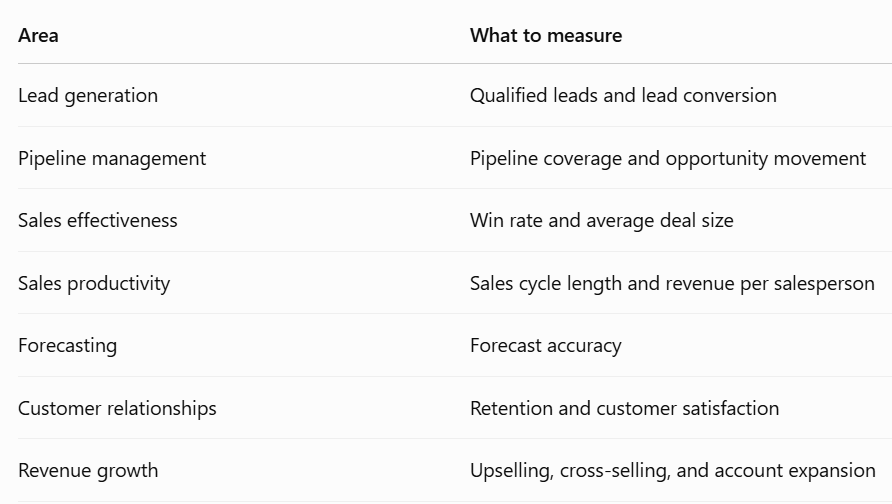
Don't measure everything just because your CRM allows you to.
Measure what helps managers make better decisions and salespeople become more effective.
4. How Can Sales Managers Improve Sales Maturity?
Here's the interesting part: improving sales maturity isn't about buying another software subscription or organizing a motivational sales conference with inspirational music.
It's about changing how your team works.
A few practical steps can make a significant difference.
1. Understand where you stand.
Evaluate your existing sales processes, team capabilities, technology, and performance. Be honest. A little reality check never hurt anyone.
2. Standardize the basics.
Create a clear sales process, define qualification criteria, establish follow-up expectations, and make sure everyone understands their responsibilities.
3. Coach, don't just monitor.
Sales managers shouldn't spend all their time asking, "Why didn't you close that deal?"
Instead, ask questions like:
What is stopping the customer from making a decision?
What could you have done differently?
What support do you need?
What's your next move?
Good coaching creates better salespeople. Constant pressure creates better excuses.
4. Use technology intelligently.
CRM systems, automation, analytics, and AI can make sales teams more productive. But technology should simplify selling, not give everyone another administrative headache.
5. Build a culture of continuous improvement.
Celebrate wins, discuss losses, share best practices, and encourage people to learn from each other.
A team that learns together has a much better chance of growing together.
5. Remember: Sales Maturity Is a Journey, Not a Trophy
One common mistake organizations make is treating sales maturity as a destination.
They reach a certain level of performance, introduce a few processes, invest in technology, and assume the job is done.
But sales maturity is an ongoing journey.
A growing organization may need to revisit its sales processes as it enters new markets. A high-performing team may need to rethink its approach when customer expectations change. Even the best salespeople need coaching, development, and fresh perspectives.
And here's something worth remembering:
You don't need to jump from Stage 1 to Stage 5 overnight.
Trying to introduce advanced analytics when your team hasn't mastered basic pipeline management is like buying a Formula 1 car before learning how to drive.
Build the fundamentals first. Improve consistently. Scale what works.
Final Thoughts: Are You Building a Sales Team or Just Managing a Sales Target?
Sales targets are important. Revenue matters. Closing deals is the name of the game.
But a truly successful sales organization does more than chase numbers at the end of every month.
It builds capable people, repeatable processes, strong customer relationships, and a culture of accountability.
A Sales Maturity Model helps managers see the bigger picture. It shows what's working, what's holding the team back, and where the next opportunity for improvement lies.
So, here's a question for your next sales team meeting:
If your best salesperson took a month off, would your sales engine continue running smoothly, or would everyone suddenly forget how to sell?
The answer might tell you more about your sales maturity than your monthly revenue report ever will.
Because great sales organizations don't depend on a few people having great months.
They build systems that help the entire team win, month after month.
Good luck hustling!
'
Next up,
We recommend you to meet the team behind making of SALESVITA. The main thing you'll want to read about next is probably. This is where the good stuff happens. Interested partnering with SALESVITA?