.
Michio Suzuki was born in 1887 in the small village of Hamamatsu in Japan. He was the son of a cotton farmer, and he began his career in the production of weaving looms. In 1909, Michio opened the Suzuki Loom Works with the goal of improving the existing design of cotton looms. Eventually, his efforts led to the production of looms designed for use in the silk industry.
The Suzuki Loom Works was restructured in 1920 so that Michio could gain access to the capital he needed to grow his business. It became the Suzuki Loom Manufacturing Company with Michio as its president. For the next three decades, the company produced quality looms, surpassing th competition as well as profit expectations. His market soon expanded from Japan to India and Southeast Asia, increasing its profitability.
While continuing his role at the helm of the Suzuki L00111 Manufacturing Company, Michio attempted to diversify his interests in order to realize even greater success. He began with the production of a small car offering a 4-stroke, 4-cylinder engine in i937. Although he was able to create a few prototypes, his efforts were discontinued at the onset of World War II. The Japanese government had decided that small cars were not important at that time and ordered production to cease.
The 1940s
During the 19405, the Suzuki Loom Manufacturing Company experienced several downturns when business leveled off dui to the durability of the looms, which held up against time and usage for decades. Damage to several plants occurred during the war, and Michio was forced to close them. The main offices were moved to the Takatsuka Plant in 1945 and remain there today. After the war, cotton production increased, creating a temporary improvement in loom sales. By the end of the decade, however, the company was experiencing financial difficulties and labor problems.
The 1950s
By 1952, Michio felt that the time had come for a change, and the Suzuki Loom Manufacturing Company began to MOVE into the area of personal transportation. In June of 1952, Suzuki launched the "Power Free," a motorized bicycle with a 36cc, 2-stroke engine. The bike featured a double-sprocket gear system. This was the beginning of the company as most people know it today - the Suzuki Motor Corporation.
The "Power Free" utilized an innovative design that combined a bicycle with an engine, allowing the rider to choose one of three riding methods. The bike could be ridden using the pedals without motorized assistance, using the pedals and motor at the same time, or using the motor only.
In the following year, Suzuki launched the "Diamond Free," a motorized bike that was entered in several motorcycle competitions. The "Diamond Free" was fitted with a 60cc, 2-stroke engine. Demand for the bike reached 6,000 units on a monthly basis, propelling the company forward with its plans to succeed in the motorized bike market.
In 1954, the company officially changed its name to Suzuki Motor Company, Ltd. By 1955, the company produced the Colleda, a 1255cc, 2-stroke motorcycle. In October of that year, the company launched the Suzulight, the first mass-produced car. The Suzulight featured a small frame, 4-wheel suspension, a 360cc, 2-stroke engine, and front-wheel drive.
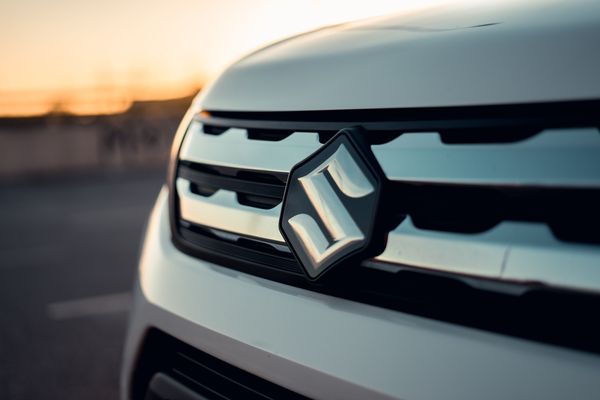
The second half of the 19505 ushered in more changes. Michio stepped down as president in 1957, taking on the role of adviser, and Shunzo Suzuki took over the role of president. In October of 1958, the company officially adopted its well-known corporate emblem of "S." In 1959, the company produced a Suzulight commercial vehicle as wel as the Colleda Sel Twin, a motorcycle with an electric starter.
The 1960s
The early 1960s brought additional changes to the company. The Suzuki Loom Works Co. was created to separate loom production completely from the motor vehicle division. In September of 1961, manufacture of the Suzulight Carry began. This lightweight truck featured a 360cc, 2-stroke engine. A new plant was built to handle production.
Suzuki entered the Isle of Man TT race in 1962, winning the 50cc-class division, an accomplishment that it repeated the next year. Recognition of the brand stimulated sales, and the company introduced its motorcycles to the United States in 1963 with the creation of a subsidiary for sales, the U.S. Suzuki Motor Corporation, which was based in Los Angeles.
Suzuki realized immediate success in the American market, a fact credited to the inexpensive cost as well as to a design that was lightweight and reliable. The company had mastered the art of mass producing motorbikes, enabling it to keep prices affordable, while still maintaining the ability to provide variety in designs. Demand in America was incredibly high, and Suzuki motorcycles sold at staggering rates.
In 1965, the company began to toy with outboard motors, quickly developing an ongoing interest in 2-stroke motors. Suzuki considered innovative features for outboard motors at this time, including a computerized control system for engine timing. In August of this year, the company introduced a subcompact passenger vehicle to the world.
The second half of this decade was just as eventful for the brand. In 1966, Suzuki chose a song and a flag to represent its company. The K50, a motorcycle, was introduced in January of 1967. In March of 1966, the first plant dedicated to the manufacture of motorcycles for the compare was created outside of Japan. It was given the name of Thai Suzuki Motor Co. and built in Thailand. Another plant was established elsewhere in Japan for the production of motor vehicles. In 1969, the company built a new plant (Oyabe, Toyama, Japan) dedicated to the manufacture of motorcycle'
The 1970s
As the 1970s arrived, the company began to gain notoriety for its ability to consistently win in the World Motocross Championships, earning it recognition as a manufacturer of quality, high-performance bikes. Sales continued to soar. As a result, several plants were built not only for mid-size and large motorcycles but also for automobiles during the first half of this decade.
In the first half of this decade, the Fronte 71, a mini-vehicle was produced along with the Fronte Coupe, another mini-vehicle. The GT750, a 750cc, 2-stroke motorcycle, and the GT380, a 371cc, 2-stroke motorcycle, followed shortly thereafter. A direct sales subsidiary was opened in Akita, Japan in 1972, another sign that the company was continuing to grow successfully.
The company made a bold move in 1973 and established Suzu Parts Mfg. CO., Ltd, to produce parts for its vehicles. Later, in 1974, P.T. Suzuki Indonesia Manufacturing was set up in Jakarta, Indonesia to assist with parts production.
Shunzo Suzuki stepped down as president in 1973 to become acting chairman, turning over his spot to Jitsujiro Suzuki. Shortly after this change in leadership, a direct sales subsidiary was opened in Ontario, Canada.
In 1974, the company developed and manufactured a motoriz wheelchair, propelling the business into the market of specialized medical equipment. The brand's expansion continued with the introduction of a prefabricated storage shed as well as a prefabricated house. In May of 1975, the company expanded its car production into Pakistan. This enterprise got off to a rocky start due to compliance issues with emission requirements.
As the middle of this decade approached, Suzuki experimented with a rotary engine, producing the RE5. This model never caught on in popularity, so it did not join the ranks of mass-produced bikes. As a result, the bike earned the distinction of becoming a collector's bike. At this same time, the 2-stroke CR 750 gained popularity as a street bike, and the GS motorcycle line was launched.
In 1978, Jitsujiro Suzuki stepped down as president, taking up the reins as chairman. Osamu Suzuki stepped in to take his place. The Fronte 75 450cc mini-car, the Cervo mini-vehicle, the Fronte 75 550cc mini-car, and the Jimny 8, a subcompact car, were all introduced to the world from 1976 to 1978.
The 1980s
The company entered a decade of new changes and innovative designs as the 19805 arrived. To celebrate 60 years of success, the Machine Industry Fostering and Promoting foundation was created. A sales division was established in Australia in 1980, expanding the company's reach. Suzuki also became interested in electric generators at this time, introducing three different models for sale.
A wide variety of motor vehicles were introduced during this decade, including motorcycles (GSX750S, GSX 11005 Katana, RG250, GSX-R, and GSX-R750), scooters (Lemma 50c, Love 50cc, Ran 50cc, and Address 50cc), and mini-cars (Jimney 4x4, Alto, Alto Works, and Cervo 550cc). The company also introduced a new assortment of oil-injection outboard motors. Suzuki developed its first 4-wheeled ATV.
'